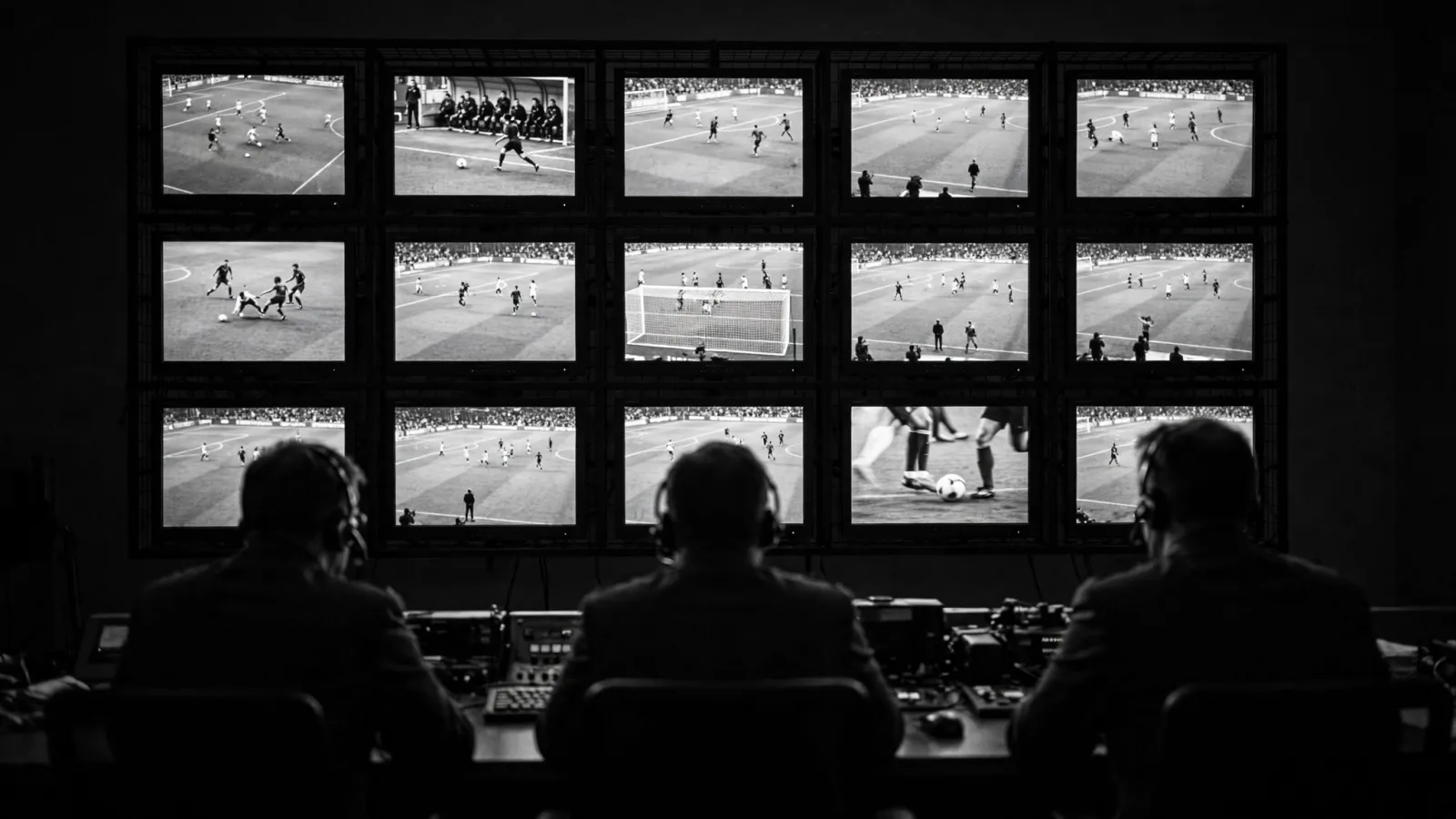
Here’s the sales pitch VAR came with: bad calls happen because referees are human, humans miss things at full speed, so let’s put a team of officials in a room full of monitors, give them every camera angle in the stadium, and pipe a verdict straight into the referee’s earpiece. Airtight logic. Should’ve worked. Instead what we got is a hidden room deciding the outcome of the match, a referee waiting on a voice in his ear, and — for the plays deemed complicated enough — a jog to a pitch-side monitor so he can personally re-watch the same replay the room already decided on four minutes ago. We didn’t remove the human error. We just added more humans, put them behind a door, and charged rent.
Egypt’s federation is now formally on record saying the video review system cost them a goal against Argentina — a strike from Mostafa Zico that stood on the field, got sent upstairs, and came back disallowed for a foul in the buildup that apparently only the algorithm and its operators could see. Whether or not you buy Egypt’s version, the fact that a national federation is filing an actual complaint about a system installed specifically to prevent this kind of complaint should tell you everything about how the rollout is going. This is like hiring a fact-checker and having them start more arguments than the article did.
The whole premise of VAR was that human eyes are the weak link. So the fix was: more human eyes, in a room, off-camera, taking longer, and still landing on a decision every neutral in the stadium sarcastically applauds in the exact same unified way they used to sarcastically applaud a bad call from a guy with a whistle. We spent tens of millions of dollars to relocate the argument from the pitch to a bunker. Progress.
Here’s what’s actually happening while everyone waits: a video operations room, somewhere off the pitch, packed with officials sitting in front of a wall of monitors, running back four or five camera angles on the same three seconds of contact, arguing among themselves about whether it’s worth stopping a live match over. Sometimes that’s the whole story — a verdict gets radioed straight into the referee’s earpiece and play resumes with zero explanation to the 80,000 people who just watched him stand there listening to a voice. Other times, for the ones the room decides need a second opinion, the referee jogs to a monitor at the edge of the pitch, throws up both hands to frame the universal “let’s roll the tape” rectangle, and watches — alone, live, on a delay — the exact same replay a room full of people already reviewed minutes earlier. Either way, nothing about the actual deliberation is broadcast. No audio, no vote count, no whiteboard. The room that makes the call never appears on screen at all; you just get a referee’s face and a hand gesture once the door’s decision reaches him.
Broadcasters figured out the dead air problem fast, by the way — not by fixing it, by monetizing it. The hydration breaks and stoppages built into this tournament for legitimate heat-safety reasons have quietly become the new commercial slot, which means the sport paused a live, sold-out, globally watched match so you could sit through an ad for a truck. Nobody asked for the World Cup to develop a halftime-within-the-half, but here we are, waiting on a room we’ll never see while a 30-second spot plays for people who left to get nachos four minutes ago.
A blown call in real time, made by a guy sprinting at full speed with one angle and no replay, was at least an understandable kind of wrong. Everyone got it. Humans miss things. That’s not a controversy, that’s Tuesday. What VAR delivers instead is a wrong call with a paper trail — multiple camera angles, a committee, several minutes of deliberation — and the confident public presentation of “we checked, this is correct,” when the correct version still splits every living room in the world right down the middle. That’s a worse kind of wrong. It’s wrong with a badge on.
If the review process actually settled arguments, the four-minute wait might be worth it. It doesn’t. Egypt’s federation didn’t go quiet after the review — they escalated. Nobody watching a disputed VAR call anywhere in this tournament has ever said “well, now that a committee looked at it, I fully agree.” The delay didn’t buy certainty. It just bought a longer commercial break and a slower version of the exact same fight.
VAR wasn’t built to eliminate controversy. It was built to eliminate the appearance of controversy, by wrapping a judgment call in enough technology that it looks like math. It isn’t math. It’s still a handful of people deciding what they think they saw — they just get to do it in private, on delay, while you watch a truck ad and wait to find out if the goal counts.